Showing posts with label protein purification. Show all posts

Monday, 8 September 2014

A Swift Introduction to Electrophoresis


Electrophoresis is a very common technology used in many different types of protein analysis, no matter if the protein of interest is purified or part of a complex sample. When optimizing conditions for expression of recombinant proteins, electrophoresis can be used to obtain information about protein yield at various conditions. Additionally electrophoresis can be used subsequently to purification by gel filtration, to verify protein purity and to confirm that the purified protein has correct molecular weight.

Electrophoresis of proteins is usually carried out by loading a sample into a well, to which a voltage is then applied; the varying size, shape and charge of molecules makes them move through the matrix at different velocities. At the end of the separation, the proteins are detectable as bands at different positions in the matrix.

Gel electrophoresis, as a means to separate proteins, is usually performed under denaturing conditions imparted by the presence of the detergent, SDS, both in the sample and as a constituent of the gel and running buffer. 1.4 g of SDS will bind to each gram of protein, so that any inherent charge on the protein is masked by the coating of negatively charged detergent micelles. Denaturing gels can be run under reducing conditions, where a reducing agent such as dithiothreitol (DTT) or β-mercaptoethanol is added to the sample buffer and heated. These reagents act by cleaving disulfide bonds between cysteine residues to disrupt the quaternary and tertiary structure of the proteins, creating linear chains of polypeptides. Proteins treated in this way migrate at rates that are a linear function of the logarithm of their molecular weights.

Alternatively, denaturing gels can be run under non-reducing conditions (no sample boiling and no added reducing agent) when it is important to maintain the native structure of proteins for further analysis.

Polyacrylamide gels, both as homogenous and as gradient, are the most commonly used matrices in for separation of proteins. In a complex sample where separation is desired over a wide range of molecular weights, a gradient gel with increasing gel density should be used. In such a gel, over a given time, small proteins will reach dense regions of the gel while larger proteins will migrate within less dense regions.


Hopefully that brief of electrophoresis was helpful but for more detail and information on its use please download our free handbook guide to protein purification or ask a question via the comments section below. Thanks for reading 

Monday, 21 July 2014

Getting Started on our DHFR Project


Time to get to our DHFR project. As we have explained before our aim is to express, purify and do some characterization of DHFR while learning a few things along the way.

In our previous posts, we discussed how to plan a project, identify the key characteristics of your sample and target protein, along with reviewing the key analysis methods to be aware of. We also looked at the thinking around whether you should tag your protein or not and looked at the key/common tags.

With that in mind, a couple of things we need to consider; since we are planning to characterize DHFR using biophysical methods, we are aiming for milligram levels of active protein at a purity of more than 95 %. For our purposes, it would make sense to add a small tag, such as the Histidine tag (unlikely to interfere with our analysis methods and would simplify the purification process). However, since we are doing this to learn and demonstrate how to use protein expression, purification and analysis methodologies and the large variety of tools and techniques, we have (deep breath :) taken the decision to express and purify human DHFR without a tag. Hopefully, this will not be too complicated.

Among the methodologies we plan to use, we have already discussed CIPP – Capture, Intermediate Purification, and Polishing. Another methodology that we plan to use throughout our project is Design of Experiments (DoE). DoE is a structured approach to experimental planning that provides a framework to explore parameters that may influence the outcome of your protocol. It will help you minimize the number of experiments that you have to carry out, while maximizing the information you get out of them in order to improve or optimize your desired outcomes. As it should add logic and structure, we will try to apply DoE to protein expression, purification and any other opportunities that we may come across as our project progresses.

In our experiment, the first step is expression. To express DHFR, we have chosen the most common host, E. coli. There are many different systems that can be used (and we will review the pros and cons of the most common in a future post) but we chose E. coli as it is simple, fast, reliable, low-cost, and easy to get high expression levels (remember we need 95%). One drawback with this host is that there are no post-translation modifications, such as glycosylation. With this choice of host, there is also a chance that we will get our protein expressed in inclusion bodies. While this would require having to refold the protein, it may not be a negative thing for the purification, since the inclusion bodies precipitate and therefore can be easily isolated, plus you get very high purity of your target protein if it is expressed in IBs. 

In our next post, we will look at the gene construct, vector and the cloning of the DHFR expression vector in the E. coli host. 

Meanwhile, if you are interested in learning more about Design of Experiments for protein expression and purification, you can take a look at our handbook.


Friday, 27 June 2014

How to Select the Analysis Methods for Your Protein Project

Proteins can be analysed in a multitude of ways using a plethora of techniques. When it comes to protein purification, there are certain pieces of information about your protein that you are always interested in collecting. Any other aspects you may need to measure are decided by the nature of your research project.

For protein purification, the key pieces of information are identity, purity, size homogeneity, activity and concentration of your target protein (it is also worth trying to get some information about any key impurities as well).

Determining protein purity
Without doubt, the most common technique for determining protein purity is denaturing gel electrophoresis by sodium dodecyl sulfate polyacrylamide gel electrophoresis (SDS-PAGE). This technique separates proteins by size and allows various detection techniques to be used. Classic methods include Coomassie and silver staining, but more and more pre-labeling using a fluorescent dye is gaining in popularity. The classic staining methods use photographic detection using CCD digital imagers (or film if you're lab is old school :) which are robust but less sensitive and quantitative compared to fluorescent pre-labelling.

Alternatives to SDS-PAGE for purity analysis include 2-D PAGE, size exclusion chromatography, and mass spectrometry (Matrix-assisted laser desorption/ionization; MALDI-MS).

Measuring protein identity
The most common technique used for protein identity is western blotting. Western blotting uses denaturing SDS-PAGE gel electrophoresis followed by transfer of the separated proteins to a membrane. These proteins are then detected by a specific antibody and a secondary functionalized antibody which enables detection by chemiluminescence or fluorescence.
Mass spectrometry in combination with reverse phase chromatography, can provide an easy and fast complement or alternative to the antibody-based detection step in western blotting. The main drawback is that you need to have access to a mass spectrometer, a significant piece of kit and often a shared service. The main principle for confirming protein identity using mass-spectrometry is to trypsinate the SDS-PAGE gel band of interest prior to mass analysis. To identify the peptides, Electrospray Ionization (ESI) connected on-line with reverse phase chromatography is common. The mass-spectrum of peptide species after trypsinization provides a unique fingerprint for most proteins, which can be identified using a database lookup.

Use SEC in combination with SDS-PAGE for size homogeneity


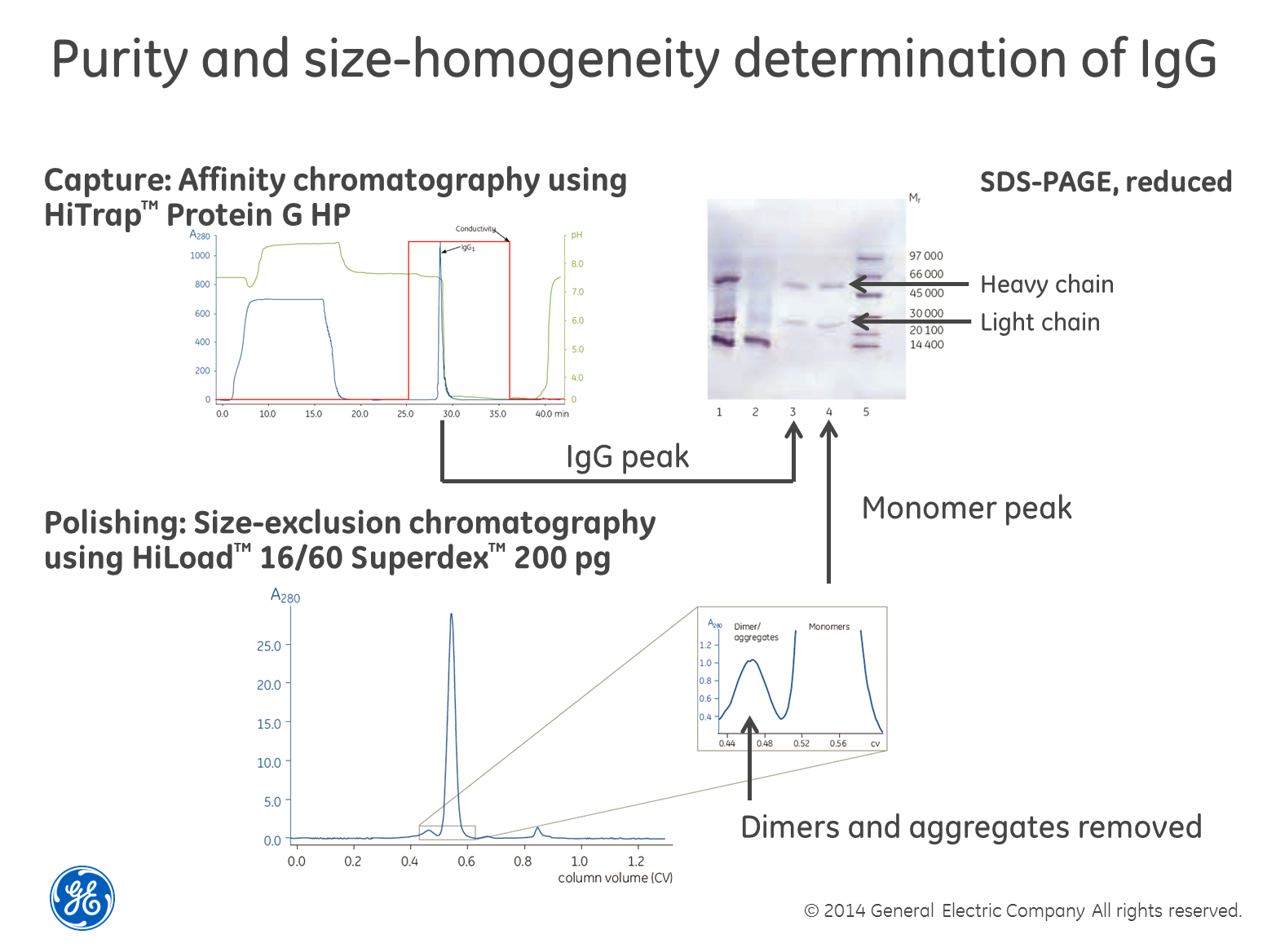
Perhaps the most robust and powerful way of determining size homogeneity is to first separate your sample using size-exclusion chromatography (SEC), collect the fractions and then run a SDS-PAGE gel containing reducing agents such as dithiothreitol (DTT) on the fractions. The reducing agent breaks di-sulfide bridges between cysteine residues and the gel shows single-chain sub-units of the different sizes, if cysteins are causing multimerization. The textbook example is the combined purification and analysis of IgG as exemplified in the image above. The only drawback we can think of with this method is that if you have a low concentration of the protein in your sample, it may be difficult to detect. You also need to choose a SEC column with the right separation range for your protein of course.
Alternatives to this approach include using light-scattering or mass-spectrometry after the SEC step. Again, these detection techniques involve investment in expensive instruments.

Estimating concentration
As the subhead suggests, we think regardless of what measurement technique you use, you are likely to end up with nothing more than an estimation of the concentration. That said, measuring concentration is a chapter of its own (something we’re going to discuss in detail in future posts) but unfortunately no protein concentration assay method exists that is either specific to proteins or uniformly sensitive to all protein types (i.e. not affected by differences in protein composition). It is therefore important to choose the method that is most compatible with the sample and will give enough information for you to move forward with you research. 
For example, one of the most common methods when you want to check the expression level of you target protein from cultivation is to do a rough estimation with SDS-PAGE; it will show if you are on track. If you want to measure the total protein concentration the tried and tested methods are the Coomassie (Bradford) protein assay, BCA protein assay (also known as Smith assay) and UV absorbance at 280nm. 

Each of these methods has its own set of advantages and disadvantages. However, these methods give only an estimation of the total protein concentration. Because no method can be considered the ideal assay method for all circumstances, most researchers have more than one type of protein assay available in their laboratories. The BCA Protein Assay and Bradford Protein Assay methods are complementary and cover most samples, with both based on detection of color change. BCA is a two-step protocol including a Protein-copper chelation and secondary detection of the reduced copper. Bradford is a protein-dye binding and direct detection of the color change associated with the bound dye.

When choosing an assay somethings to consider:

•Compatibility with the sample type and components (e.g. in lysis buffer) that may interfere with the protein and/or the reagents in the assay used

•The concentration range of the assay and required sample volume. For example the Bradford assay works in a concentration range of 125–1,000 μg BSA /ml and the BCA assay in a working range of 20-2000μg BSA/ml

• Protein compositional differences which end up in different amount of color in the final solution and may give wrong concentrations- choose assay and protein standard which will minimise this error

•Speed and convenience for the number of samples to be tested

•Availability of spectrophotometer or plate reader

If your protein is an enzyme with activity in a specific enzymatic assay, using an assay may be an easy way to find out where in your eluted purification fractions the target protein is. You will then be able to detect your protein through all purification steps and have full control of the design of the purification protocol and quality of the obtained preparation. The activity is also an insurance that the protein is obtained in its native state.

We will go through the methods described in upcoming posts when we delve into our DHFR project. 

In the meantime, thanks for reading and if you have any questions let us know via the comments section below.  

Friday, 6 June 2014

Pairing your Protein with a Purification Tag

With the introduction of affinity tagging of proteins, protein purification was dramatically simplified; generic protocols could now be used, which enabled much more efficient and easy protein purification. This led to tags that do more than just purify protein, such as improving the solubility or stability.
In this post we’ll look at the characteristics, pros and cons of the most common tags used in protein purification today.

The “classic” His-tag
The histidine tag is by far the most commonly used tag for protein purification today. The reason for this is simple – it is so small that it is unlikely that it will interfere with the structure or function of the protein. This means that you don’t necessarily have to remove it before using the purified protein (one example when the his-tag often needs to be removed is for structure determination using X-ray crystallography). Another great benefit of using this tag is that purification is quite straightforward, and there is a great selection of ready-to-use purification products in a multitude of formats available to choose from. Different chromatography media are available that will provide different trade-offs between recovery, capacity and purity.
Adding histidine tag means that you typically add 4-6, sometimes up to 10, histidine residues to either the N- or the C-terminal of your protein. The aromatic group of the histidine residues bind to chelated di-valent metal ions. Nickel is the most commonly used, but Cobalt, Zinc and Copper can also be used. Zinc is the best choice for the environment. Regardless of the ion, imidazole is always used for the elution.
The main drawback of this tag is that it often requires some optimization of the imidazole concentration in your sample and in the buffers for column equilibration and wash in order to minimize binding of other host cell proteins with high histidine content.

Strep-tag™ II
Strep-tag II is a peptide tag that binds very specifically to Streptactin™, which is a modified version of streptavidin. Being small, it shares the benefits of the His-tag, and adds significant improvement in the purity you can expect.
In addition to the chromatography media being more expensive and having much lower binding capacity than media for purification of his-tagged proteins, the agent used for elution, desthiobiotin, is more expensive than imidazole.

GST for purity and solubility
Another very common tag is the enzyme Glutathione-S-Transferase (GST). It binds very specifically to glutathione immobilized on chromatography media, and therefore often gives very high purity. Another benefit is that it can also increase the solubility of the protein it is fused to. However, being big (26 kDa) it often needs to be cleaved off in order to eliminate interference with structure and function of your protein.
While there are chromatography media with high binding capacity, the kinetics of the binding is slow. The latter means that sample loading needs to be done at low flow-rates and therefore will take longer compared to e.g. a his-tagged protein.

MBP tag
Maltose Binding Protein (MBP) is another protein tag that can be used for purification and as an alternative to GST. Whilst providing the same benefit of high specificity and ability to improve solubility of your protein, it is larger than GST, so typically requires removal prior to using your protein. Lower binding capacity compared to GST and a more limited number of purification products available make this tag a second choice if the GST-tag for some reason does not work.

FLAG™ tag
If none of the to the tags discussed above work, the FLAG peptide-tag is a small tag that binds very specifically to a specific antibody currently only available on one type of chromatography media. In addition to the high specificity and thereby purity that can be expected, another benefit of this tag is that it is small, and therefore is unlikely to interfere with the function of the protein it is fused to.
The main drawback is that the affinity media is based on an immobilized antibody, and therefore has a limited binding capacity, resulting in either larger column sizes or smaller amounts purified per batch. The chromatography media also comes at a higher cost than alternative affinity media.


Key + low +++ high

Conclusion
There are many other tags that you can use but we hope this overview will give you ideas for what you should consider when choosing a tag for your protein. The key is to know your protein and the tag’s characteristics for a good choice and purification.

For more information, tips and ideas on tagged proteins, view our webinar with Professor Richard Burgess, Editor in Chief of the journal Protein Expression and Purification, and also check out this excellent collection of papers collated by Dr Richard R. Burgess which is an excellent review and includes research articles illustrating many of the purification tags in current use, including detailed experimental descriptions, example protocols, strategies and best practices for using tags.
What experiences to do you have from such tags? Have you seen other benefits or drawbacks when using the tags described here? Please use the comment field below to share your thoughts.

Wednesday, 14 May 2014

When should I use a tag to purify my protein? (and when not?)

Sometimes we’re not particularly interested in purifying proteins. We just want to get it over and done with so as to get on with the experiments that will help us understand it role. This is where tagging your protein with something that adds biospecific affinity comes in handy. It allows you to simplify the purification protocol greatly, sometimes to the extent that you can use a standard protocol.

Remember though, tagging may not always be the right solution as adding a tag can introduce changes compared to the native protein, leading to undesirable effects. For example, if you are interested in drawing conclusions about function, having a tag may introduce uncertainty, or worse,  totally destroy or alters the function of your target protein. 

Also the tag itself can interfere with your ability to use the protein the way you want; important in using therapeutic proteins, where you want to be as close to the native form as possible. In most situations though tags, especially small ones like a His-tag, have no negative affects in terms of biophysical characterisation.

If you need a protein in native form

If you have decided that you need to have your protein in the native form, you can express it without a tag and go through the process of designing a protocol involving multiple chromatographic purification steps. It can be a little tedious and potentially unnecessary. Nowadays, with so many proteins already having been expressed, it is likely that you will be able to find existing scientific literature with information on your purified your protein, or an analogue.

As an alternative to expressing and purifying the native form, you can tag your protein and then remove it later. Whilst this simplifies the purification protocol, you’ll have to figure out what tag to use and how to remove it. You will also have to add the steps for cleaving the tag (manually removing it) to your protocol. It does not always have to be manual; there are systems such as AKTA pure that can automate this for you.

Removing the tag sometimes  isn’t very straightforward. It always includes using a sequence specific protease. The blood factors Thrombin & Factor Xa are most commonly used for this, but you need to make sure that their respective cleavage sequences (LVPR↓GS and IEGR↓) are not present in your target protein. Some tags, such as the Glutathione-S-Transferase (GST)-tag can be removed with a more specific proteases, such as PreScission protease (human rhinovirus 3C protease, cleavage sequence LEVLFQ↓GP), and this is extremely unlikely to effect your protein.

If you don’t need a protein in its native form

In addition to using a tag to simplify the purification process, there are actually a number of other benefits
  • A tag can add the ability to use a generic detection method (such as a standard tag-specific western-blotting antibody, or an enzymatic assay in the case of the GST-tag)
  • It may actually help overcome some challenges with your protein e.g. by stabilizing it or making it more soluble, as shown in this (very cool :) example of how a challenging spider silk protein was purified by using a special solubility tag in addition to a Histidine-tag
  • Some tags can be fused to proteins for a broad range of other applications such as—labeling for imaging and localization studies, protein–protein interaction studies, and subcellular localization or transduction
  • Tags also allow strong binding to chromatographic affinity media in the presence of denaturants which makes it possible to purify a protein that requires this, e.g. if it has been expressed in inclusion bodies. In this case, you can then also try to perform refolding of the protein while it is still bound to the column (too complex to describe here, we will discuss this in-depth in a future post..)
Pros
Cons
Using a tag


Simple, generic purification using affinity chromatography (AC) as a first step
Tag may interfere with protein structure and affect folding and biological activity
Tags are easy to detect, in comparison to the target protein, which allows for a generic detection method
If tag needs to be removed, cleavage may not always be achieved at 100 % and sometimes some amino acids may be left
Solubility and stability can be improved
Only some tags can be used under denaturing conditions


Purifying a native protein


Tag removal is not necessary
The purification and detection protocols need to be designed specifically
Purification can always be done under denaturing conditions
Problems with solubility and stability may be   difficult to overcome and may need special protocols to be developed
       
In summary, tag if you can – it simplifies your purification work massively, but don’t be afraid to express and purify your protein in its native form. 

Let us know your experiences working with tags, preferences and if you have any questions in the comments. Next time, we will look at the pros and cons of the most common tags used for protein purification.